
Finance
Term Life Insurance
A young Indian family standing together with the headline “Protect Your Family’s Future with Term Insurance.”
19 Oct 2026 · Rajendra Prasad Shah
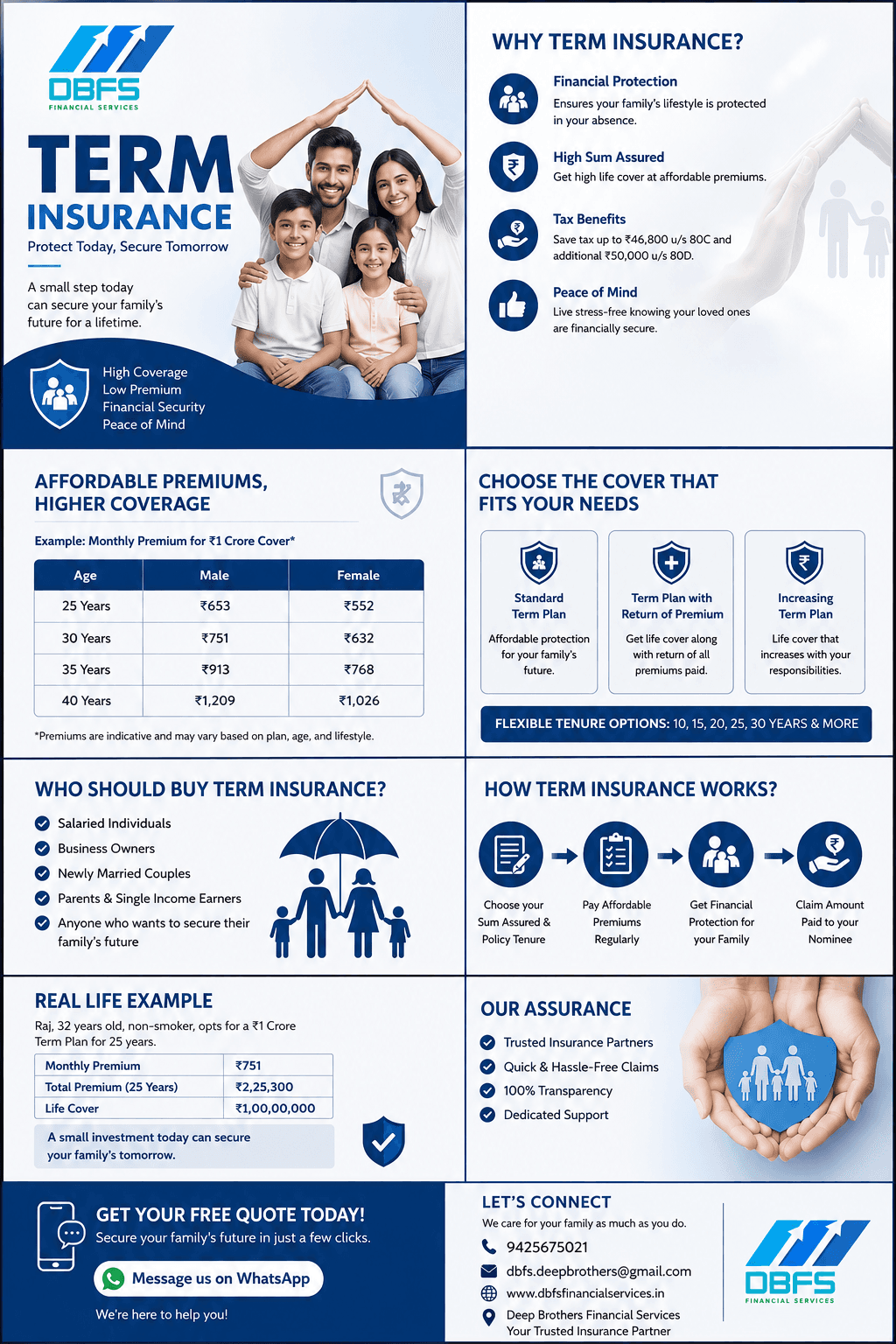
Term Life Insurance: A Complete Guide to Protecting Your Family’s Financial Future.
Introduction
Life is unpredictable, and protecting your family's financial future is one of the most important responsibilities you have. If your family depends on your income for household expenses, children's education, loan repayments, or other financial goals, what would happen if you were no longer there to support them?
This is where term life insurance can help.
Term insurance is a type of life insurance that provides financial protection to your family for a specified period. In the event of the insured person's death during the policy term, the insurer pays the applicable death benefit to the nominee, subject to the policy's terms and conditions.
In this guide, we will explain how term life insurance works, its benefits, how much coverage you may need, and how to select a suitable plan in India.
What Is Term Life Insurance?
Term life insurance is a life insurance policy designed primarily to provide financial protection for a fixed period, such as 20, 30, or 40 years, depending on the insurer's offerings and the policyholder's eligibility.
You pay premiums according to the policy terms, and the insurer provides life cover during the specified period.
If the insured person dies while the policy is active and the claim is admissible, the nominee receives the applicable death benefit.
For example, suppose a 35-year-old individual purchases a term insurance policy with life cover of ₹1 crore for 30 years. If the insured person dies during the policy term and the claim is payable, the nominee may receive ₹1 crore under the selected benefit option.
The actual premium, eligibility, coverage, and claim conditions depend on the insurer and policy.
Why Is Term Insurance Important?
Term insurance can play an important role in family financial planning for several reasons.
1. Financial Security for Your Family
The death benefit can help your family manage household expenses and maintain financial stability after the loss of an earning member.
2. Protection Against Outstanding Loans
If you have a home loan, personal loan, or other financial obligations, a suitable life cover amount can help your family manage those liabilities.
3. Children's Education and Future Goals
Term insurance can help provide financial support for future expenses such as children's education, higher studies, and other important family goals.
4. Affordable Life Cover
Term insurance generally offers substantial life cover at a lower initial premium than many life insurance products that combine protection with savings or investment benefits. Actual premiums depend on several personal and policy-related factors.
5. Peace of Mind
Knowing that your family may receive financial support in your absence can provide greater confidence when planning for the future.
How Does Term Life Insurance Work?
Buying term insurance generally involves the following steps:
Assess your needs: Estimate your family's future expenses, outstanding liabilities, and financial goals.
Choose the coverage amount: Select an appropriate sum assured based on your income, dependants, assets, and liabilities.
Select the policy term: Choose a duration that broadly matches your financial responsibilities.
Complete the application: Provide accurate personal, income, medical, and lifestyle information.
Undergo underwriting: The insurer may assess your health, income, and other risk factors and may request medical tests.
Pay the premium: Pay the premium according to the selected payment frequency and policy terms.
Keep your policy details updated: Ensure your nominee information and contact details are accurate.
If the insured person dies during the policy term, the nominee or legal claimant can submit the required documents to the insurer for claim assessment.
How Much Term Insurance Cover Do You Need?
Choosing an appropriate life cover is one of the most important decisions when purchasing term insurance.
A useful starting point is to estimate:
Your family's annual living expenses.
Outstanding loans and other liabilities.
Future education and family goals.
The financial support your family may need over several years.
Existing life insurance, savings, and investments that could be available to your family.
For example, a person with annual household support needs of ₹8 lakh, significant outstanding loans, and children's education expenses may require a different level of cover from someone with no dependants and substantial existing assets.
Some people use annual income multiples as a preliminary estimate, but a detailed needs-based calculation is generally more useful. The right amount depends on individual circumstances and affordability.
Factors That Affect Term Insurance Premiums
The premium for a term insurance policy can vary based on several factors.
Age: Premiums are generally lower when purchasing cover at a younger age, assuming other factors remain similar.
Health condition: Medical history and current health can influence underwriting and premium decisions.
Smoking and tobacco use: Tobacco consumption can affect the insurer's risk assessment.
Coverage amount: A higher sum assured generally costs more than a lower sum assured.
Policy term: The duration of coverage can affect the premium.
Occupation and lifestyle: Certain occupations and activities may affect underwriting decisions.
Riders and benefit options: Additional benefits can increase the premium.
Providing accurate information during the application process is essential. Incorrect or incomplete disclosures can create problems during claim assessment.
Types of Term Insurance Plans
Insurers may offer different term insurance structures and benefit options.
1. Level Term Insurance
The basic life cover remains constant throughout the selected policy term.
2. Increasing Cover Term Insurance
The sum assured increases according to the policy's specified structure, which may help address changing financial responsibilities.
3. Decreasing Cover Term Insurance
The cover reduces over time according to the policy terms. This structure may be relevant for certain financial liabilities.
4. Return of Premium Term Insurance
Under eligible plans, the policy may return specified premiums if the insured person survives the policy term and meets the contractual conditions. Such plans generally have different premium structures from standard term insurance.
5. Term Insurance With Additional Riders
Eligible riders may provide additional benefits for specified events, such as accidental death or certain critical illnesses, subject to their definitions, exclusions, and conditions.
Not every option is available with every insurer or policy.
What Is the Difference Between Term Insurance and Traditional Life Insurance?
FeatureTerm InsuranceSavings-Oriented Life InsurancePrimary purposeLife protectionProtection combined with savings or other benefitsPremium structureGenerally lower for comparable life coverOften higher, depending on benefitsMaturity benefitUsually none under a standard pure term planMay be available, depending on the planInvestment componentGenerally absent in a pure term planDepends on the productBest suited toPeople prioritising financial protectionPeople considering products with defined savings or other benefits
The right choice depends on your goals, budget, and need for protection versus savings.
Important Things to Check Before Buying Term Insurance
Before purchasing a policy, review the following:
Claim settlement information: Examine the insurer's published claim statistics, understanding that historical performance does not guarantee future outcomes.
Policy exclusions: Read the terms describing circumstances in which benefits may not be payable.
Medical disclosures: Disclose existing health conditions and medical history accurately.
Premium affordability: Choose a premium you can sustain over the required period.
Policy duration: Ensure the term reasonably covers your financial responsibilities.
Nominee details: Keep nominee information accurate and updated.
Riders and conditions: Understand additional costs, eligibility requirements, exclusions, and waiting periods where applicable.
Policy documents: Read the official policy wording and benefit illustrations before making a decision.
Do not select a policy solely because it has the lowest advertised premium.
Common Mistakes to Avoid
Many buyers make avoidable mistakes when purchasing term insurance:
Waiting too long to purchase life cover.
Selecting insufficient coverage.
Providing incorrect medical or lifestyle information.
Choosing a policy term that ends before important financial responsibilities are complete.
Ignoring policy exclusions and conditions.
Failing to inform family members where the policy documents are kept.
Allowing the policy to lapse because of missed premium payments.
Careful planning and regular reviews can help you avoid these problems.
Frequently Asked Questions About Term Life Insurance
Q1. Is term life insurance worth buying?
Term insurance can be valuable for people whose families depend on their income or who have significant financial obligations. Its suitability depends on your individual circumstances.
Q2. Can I buy term insurance online?
Yes. Many insurers allow eligible applicants to apply online. The application is subject to verification, underwriting, and the insurer's requirements.
Q3. Does term insurance provide a maturity benefit?
A standard pure term plan generally does not provide a maturity benefit. Some plans offer a return-of-premium feature under specified conditions.
Q4. What happens if I survive the policy term?
For a standard pure term plan, the coverage generally ends when the policy term expires, with no maturity payout. The exact outcome depends on the selected product and policy wording.
Q5. Can I add riders to my term insurance policy?
Some insurers offer optional riders, subject to eligibility and policy conditions. Review the additional premium and coverage limitations before selecting them.
Q6. Is term insurance tax-beneficial in India?
Tax treatment depends on the applicable tax laws, the policy structure, and individual circumstances. Review the current provisions or consult a qualified tax professional before relying on a tax benefit.
Conclusion: Protect Your Family With the Right Life Cover
Term life insurance is an important financial protection tool for individuals who want to help safeguard their family's future. It can provide a financial safety net for household expenses, outstanding loans, children's education, and other responsibilities if the insured person dies during the policy term.
The key is to select an appropriate coverage amount, choose a suitable policy duration, disclose information accurately, and understand the policy conditions before purchasing.
Your family's financial security deserves thoughtful planning. Start by assessing your needs and comparing suitable term insurance options before making an informed decision.
Call to Action: Looking for guidance on term life insurance? Review your family's financial needs, compare available plans, and consult a qualified insurance adviser to understand the coverage options that may suit your circumstances.
Disclaimer: This article is for educational purposes only and does not constitute financial, tax, or insurance advice. Policy benefits, premiums, exclusions, eligibility, and claim conditions vary by insurer and product. Read the policy wording and applicable disclosures carefully before purchasing insurance.